
Youth Climate Lab presents…

COP30 opened the streets to thousands, but closed the door to many more.
COP30 was, in many ways, showcasing a positive shift. For the first time in years, public protests were permitted in the streets. Youth and civil society showed up in force. Alongside the official negotiations, a vibrant People’s Summit unfolded, and “houses” spread across the city centered conversations on the Global South, climate justice, and frontline leadership.
Seeing climate protests back in the streets mattered. It signalled that civic space, though shrinking globally, is still worth defending. The energy was real with over 70,000 marching the streets. For a brief moment, it felt like the climate movement had reclaimed some of its voice. But access on paper does not equal access in practice.
Behind the scenes, this COP was markedly less accessible than previous years. Skyrocketing accommodation prices, last-minute cancellations, changed flights, and extreme costs priced out many youth and civil society delegates. We heard repeated stories of young activists losing housing days before departure, being rebooked into unaffordable options, or being forced to cancel entirely. Indigenous representation was also difficult to access, a troubling trend for a COP so solidly focused on the Amazon where Indigenous leadership is indispensable to its climate solutions.
If COPs are meant to be an inclusive, global processes, then affordability and equitable access cannot be afterthoughts. There is significant room for improvement ahead of next year’s conference in Turkey.
And then there were the negotiations themselves. Like many COPs before it, COP30 left many participants feeling disappointed. The needle barely moved.

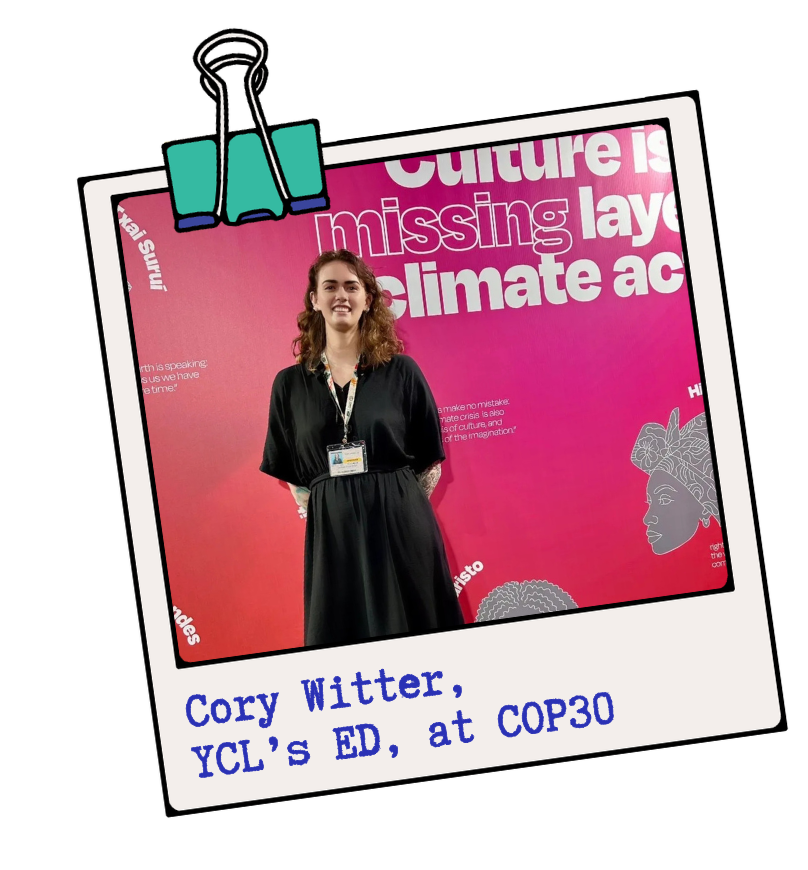
Cory’s COP30 reflections
More troubling, however, was what this COP symbolized. It reflected a broader shift in the geopolitical climate. Canada’s role this year was particularly disappointing. It was hard not to see the shift of Canada’s role on the international stage. The erosion of Canada’s belief in multilateralism clearly showed up at this COP; it was visible in the tone, who was present, and the outcomes of the negotiations. With Mark Carney notably absent and having no strong leadership demonstrated on just transition discussions, Canada appeared adrift. For the first time since 2014, Canada received the “Fossil of the Day” award (given by CAN international to « the country doing the most to do the least »). And it was rightfully deserved.
We also saw youth’s own trust in multilateral institutions continue to erode. This year, there were more fossil fuel lobbyists registered than any single national delegation except the host country, Brazil. That fact alone explains much of youth’s disenfranchisement. When you have spent what is an inaccessible amount of money for most, showed up, just to be locked out of rooms and outnumbered by fossil fuel lobbyists, cynicism and feelings of defeat are bound to rise.
Another alarming development that highlighted the shifts in global perceptions and increased polarization, was the push by some actors to remove references to transgender, non-binary, and intersex people from official texts and to enforce stricter gender definitions. Though these efforts were not ultimately incorporated, their very presence was concerning, and was often delaying important work from moving ahead. As an organization committed to accessibility and inclusivity, Youth Climate Lab engages and gives access to diverse youth at COPs each year, for us this signalled a dangerous shift. If global political tides continue to turn against LGBTQIA+ communities, international climate forums risk becoming less safe and less representative. As a queer leader in this space, I recognize more and more the privilege I have from being able to safely participate in these international spaces, as I am less visibly queer than others in the community. This is not just a social justice issue; it is a climate governance issue. Exclusion weakens solutions.
It is easy to ask: why keep showing up?
As an organization bringing youth into these spaces, we grapple with that question constantly. But the answer is simple: if we do not attend, the room is only left to fossil fuel lobbyists. Silence does not create progress. Showing up loudly still matters. Yelling in the room, even if most ignore you, is better than leaving it empty.
Even in this disappointment, there were glimmers of progress. The adoption of the Belém Action Mechanism, a just transition framework shaped significantly by civil society advocacy throughout the two weeks, stands out as a meaningful achievement. Weaving together social equity, labor rights, and climate ambition in a way that reflects sustained pressure from activists, organizers, and frontline communities.
COP30 was not a triumph. But it was clarifying.
It clarified who is fighting for an inclusive, just transition, and who is fighting to slow it down. It clarified the fragility of multilateralism. It clarified that civic space must be actively defended. And it clarified that while the system is flawed, abandoning it cannot be the solution.
Next year in Turkey, we must demand more accessible processes, stronger leadership, and firmer protections for marginalized communities. Because if these spaces are to shape our shared future, they must belong to all of us, not just those who can afford the flight.