

Northern Youth POV:
Climate Adaptation in the Northern Regions
By Carl Kodakin-Yakeleya Jr

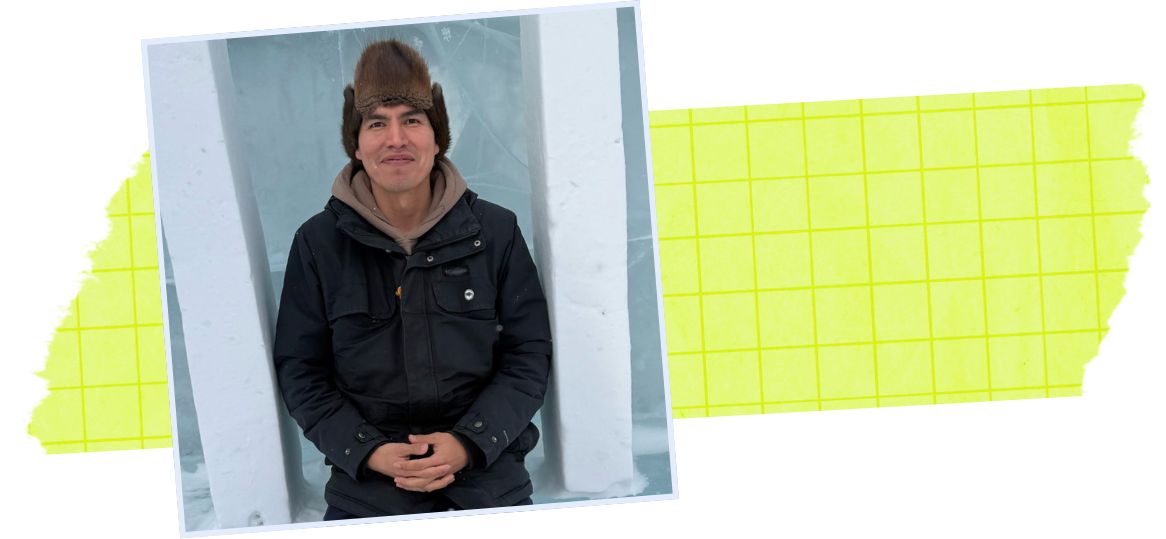

I’m in my early thirties now, but I still measure time the way my father taught me – by the freeze-up, the break-up, the depth and crunch of snow beneath my boots. Growing up on the Land, we didn’t learn survival; we learned relationship. The winters now are not the same. Ice roads open later and close earlier each year, and spiritual landmarks that have persisted for thousands of years are being swept away by record low water. This shift cuts deeper than inconvenience – it disrupts the transmission of knowledge. When travel is restricted, we do not learn where the giants make whirlpools or where to stop to make offerings.
Climate change is often reduced to percentages – degrees warming, emissions targets – but for us it shows up as a break in our way of life, in who we are as Dene. It becomes harder for young people to connect with the practices that ground identity: hunting, trapping, fishing, gathering. When those practices become less accessible, the effects ripple into mental health, language retention, and a sense of belonging.
Decisions are still made far from our territories, framed through southern timelines and priorities. Climate policy focuses on mitigation – reducing emissions through large-scale energy transitions – while adaptation funding trickles in, tied up in applications that don’t reflect our realities or capacity. At the same time, resource extraction projects continue, sometimes in the name of economic development or even “green transition,” without full respect for our governance systems.
Climate change is not separate from Indigenous sovereignty – it’s entangled with it. When our rights to steward and govern our territories are limited, so is our ability to respond. When policy frameworks treat us as stakeholders instead of nations, they miss the depth of knowledge and intimacy we carry with these ecosystems.
Our ways of knowing are not just cultural – they are practical, adaptive, and tested over generations. My Elders never call it “climate science,” but they understand patterns, shifts, and relationships. Many of us in the North have grown up on or close to the Land and need support to continue apprenticing under the Elders. The boreal forest, one of the world’s largest carbon sinks, carries a responsibility we hold not just for ourselves but for the globe. We are not a wilderness to be developed. We steward these vast landscapes so the animals and plants can thrive.
We are sold the colonial story of dependence on the South, but the truth is in reverse. Governments apologize for relocations while still using us as checker pieces in Arctic sovereignty. Investment comes when convenient and leaves when the lifeblood of our Lands and People has run dry.
I think about my own young children and what they’re inheriting. They are growing up in a time when the Land is changing faster than our stories once prepared us for. But they are strong, and they are asking hard questions about who makes decisions and why.
For me, the path forward isn’t adaptation – it’s restoring balance and honouring the authority of our knowledge holders. When Indigenous governance leads, when our laws and relationships to the Land are respected, solutions look different. They are not only about managing risk; they are about renewing connection. The next generation should do more than just survive these changes, they should also stand firmly in who they are with the Land still speaking – and being heard.